Dolphin Tour with Kids from Portimão: Searching, Not Seeing
Updated September 6, 2026 · 4 min read
Of all the tours you can book from Portimão, the dolphin tour makes the biggest promise – and it’s the only one that can fail to keep it. The cave tour shows a cave. The sunset happens. Dolphins are wild animals in the open Atlantic; they aren’t fed, kept or tracked. A child you’ve told “we’re going to see dolphins” can come ashore two hours later empty-handed.
This article isn’t about when the odds are best – that’s the seasonal question, covered in When to See Dolphins in the Algarve. This one is about the question with kids: what actually happens on this tour, and how to prepare a child for it beforehand.
Why the dolphin search looks different from the cave tour
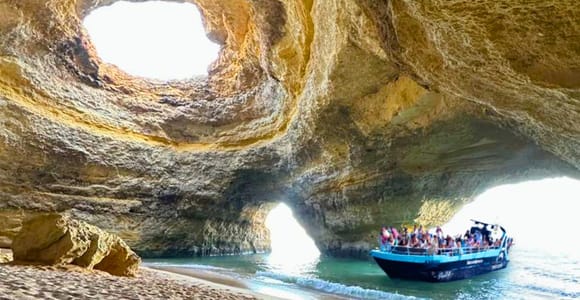
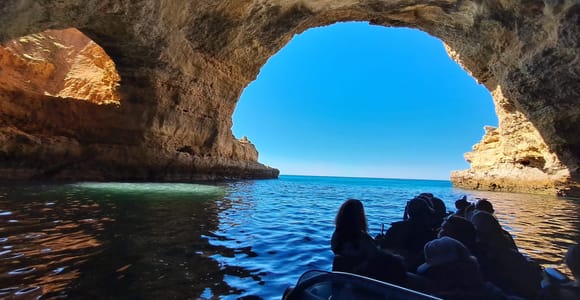
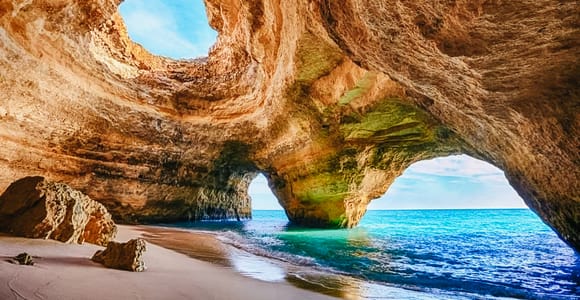
This is the point that matters from Portimão, and that no booking page mentions. Benagil Cave lies around ten kilometres east of the harbour entrance, right against the cliff. The boat runs along the shore, and there’s always something to see: rocks, arches, beaches, other boats.
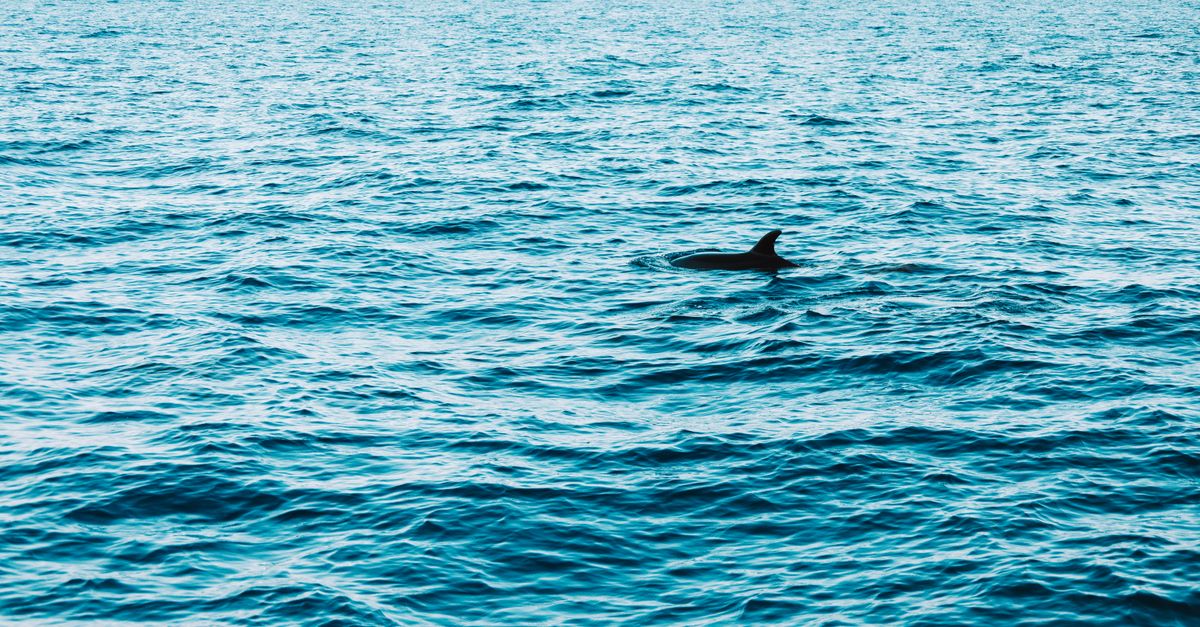
Dolphins are searched for in the other direction – out to sea. The pods move through open water off the coast, not beneath the cliffs. In practice that means the boat leaves the long marina channel, turns out to sea and heads off quickly in one direction, until at some point there’s nothing left but water and horizon. The crew scans for dorsal fins, often for half an hour at a stretch, sometimes longer. It’s loud, windy and wet the whole time, and to a child every minute looks like the last.
When something does appear, it’s rarely the picture from the brochure. More often it’s fins some distance away, a few jumps, two to five minutes, then the pod moves on. That’s a good sighting. It just doesn’t feel like one if someone came aboard expecting something else.
The sentence that matters
Don’t tell the child you’re going to see dolphins. Tell them you’re going out to search for dolphins. The difference sounds like hair-splitting, and it decides the whole day.
It helps to explain to the child beforehand:
- Dolphins don’t live in one fixed spot. Nobody knows in the morning where they’ll be that day.
- We’re going far out. Part of the trip is just looking at water – that’s part of the search.
- If we find some, they’re gone quickly. You see fins, not whole dolphins.
- If we don’t find any, it was still a boat trip.
A child who boards with this picture in mind experiences every sighting as a win. A child who was promised a dolphin show experiences even a good sighting as too little.
What sighting rates are worth
Almost every operator quotes a rate. The numbers differ between operators, and wherever one is stated, it’s on that operator’s own booking page – we deliberately don’t give one of our own here. More important than the figure is what such a rate actually is: an experience-based number from past trips, not a promise for your trip. Nor does it say anything about how close, how long or how spectacular a sighting will be. What’s counted is the encounter, not the experience.
Some operators offer a second trip if nothing was seen. That, too, is not a general standard but a condition on the booking page – read it before you book. And factor in the family problem behind it: a replacement trip only helps if you still have days left on site and the free slots fit your daily schedule. Anyone who books the dolphin tour on the last day of the holiday effectively has no second chance.
Why combining it usually is the better booking with kids
From Portimão there are 13 dolphin offers, from €30, averaging €40. What’s notable is which of these have made it into the twenty most-booked tours in the region: not a pure dolphin trip, but two combinations. The cave-and-dolphin tour with a marine biologist costs €40, lasts two and a half hours and has 4,698 reviews at 4.8 stars. A premium cave tour with a dolphin search comes in at €42 for two hours, 1,600 reviews, 4.4 stars.
The reason is exactly the point of this article: the combination has a fallback. If the sea stays empty, the day was still a cave tour – and the caves deliver, because they’re there. For adults specifically after dolphins, a pure trip can be the right choice. For kids, the risk of a pure trip is poorly rewarded. The selection is at Dolphin Watching and Benagil Cave Tours. Whether the biologist on board is worth the extra cost is covered in Dolphin Tour with a Marine Biologist.
Age, boat, duration
There’s no fixed minimum age for dolphin tours – operators set different limits, and it’s stated on the relevant booking page. Worth checking especially for speedboats, see Minimum Age on Boat Tours.
More important in practice is the type of boat. Searching out there means travel time at speed, and beyond the cliff line the Atlantic has a different swell than the coastal stretch. A larger, more steadily running boat or a catamaran is the more comfortable choice with smaller children than the RIB, even though the RIB gets closer to the animals. If your child is prone to seasickness, check with a pharmacy or a paediatrician before the trip; what else helps on board is covered in Seasickness on the Boat Trip. Which tours are generally family-friendly: Boat Trips with Kids.
When you’d better not book it with kids
- If the child is still small and the caves would be the actual goal. Then book the cave tour. The dolphin search extends the trip into open water without guaranteeing anything.
- On the last day of the holiday. No reserve, no second trip, and in rough seas the tour simply doesn’t run, with no replacement.
- If you’re using it as a consolation prize for a rainy day. That’s exactly when conditions are poor and disappointment more likely.
- If you’ve already promised it to the child. Then correct the promise before you board – not after.
A dolphin tour with kids is not a guaranteed programme item. It’s an outing with an open outcome. Sell it that way, and you get a good day, whatever turns up.